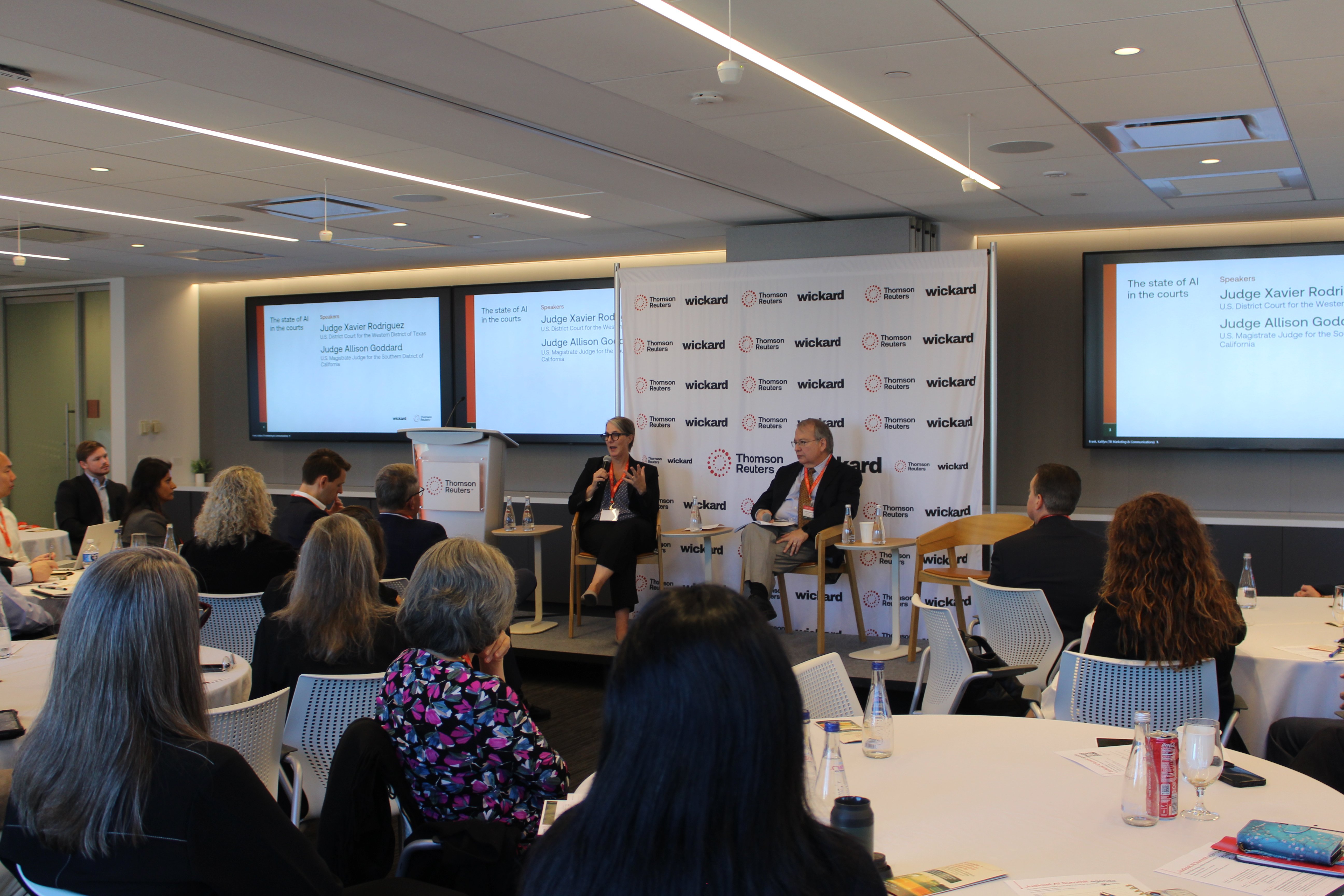
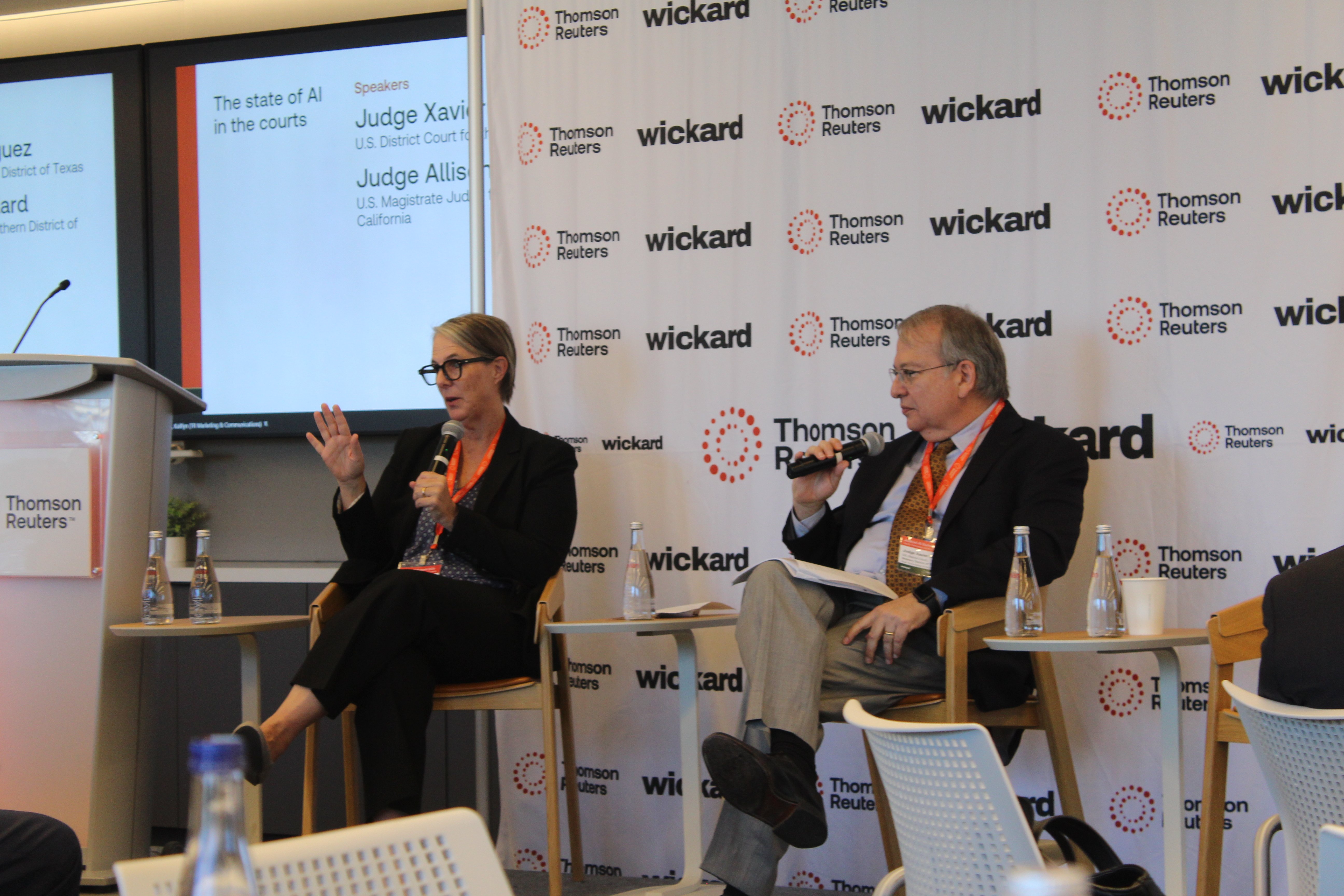
Wickard and Thomson Reuters hosted the inaugural Thomson Reuters–Wickard Judicial AI Summit: Courts, Technology, and the Future of Justice on October 8 at Thomson Reuters' headquarters in Times Square, New York City.
The invitation-only event brought together federal and state judges, judicial leaders, legal academics, government officials, and legal technology professionals from across the United States to examine the opportunities and challenges presented by artificial intelligence in the judicial system.
The summit was co-produced by Wickard and Thomson Reuters, with academic co-sponsorship from Washington University School of Law and the University of Michigan Law School.
Distinguished Judicial Speakers and Participants
The summit featured judges from federal and state courts across the country, including:
· Hon. Xavier Rodriguez, U.S. District Judge, Western District of Texas
· Hon. Allison Goddard, U.S. Magistrate Judge, Southern District of California
· Hon. Stephen R. Clark, Chief U.S. District Judge, Eastern District of Missouri
· Hon. David K. Overstreet, Justice, Illinois Supreme Court
· Hon. Joshua Deahl, Associate Judge, District of Columbia Court of Appeals
· Hon. Martin B. McGee, Senior Resident Superior Court Judge, North Carolina
· Hon. Sarah D. Smith, Judge, Third Judicial Circuit of Illinois
· Hon. Maritza Dominguez Braswell, U.S. Magistrate Judge, District of Colorado
· Hon. Brian D. Palmucci, Associate Justice, Massachusetts District Court
· Hon. Walter M. Spader, Jr., Judge, Connecticut Superior Court
Additional speakers included Louis J. Capozzi III, Solicitor General of Missouri; Kim Baker, Senior AI Solutions Architect for CoCounsel Courts at Thomson Reuters; Zach Ratzman, Director of Know-How, Government, at Thomson Reuters; Rabihah Butler, Manager of Enterprise Content at Thomson Reuters Institute; and Oliver Roberts, Founder and CEO of Wickard and Co-Director of the Washington University School of Law AI Collaborative.
Exploring AI's Impact on the Courts
The summit featured keynote presentations, judicial discussions, and technology demonstrations examining how artificial intelligence is influencing court operations and judicial decision-making.
Discussions focused on several significant developments:
Judicial AI adoption: How judges and court personnel can responsibly incorporate AI into legal research, case preparation, and administrative workflows.
AI-generated filings and hallucinations: The increasing prevalence of fabricated legal authorities, the appropriate judicial response, and related questions involving sanctions and professional responsibility.
Synthetic evidence and deepfakes: Emerging challenges associated with AI-generated audio, video, images, and other potentially manipulated evidence.
Access to justice: Opportunities for AI to assist self-represented litigants while creating additional challenges for courts evaluating AI-assisted submissions.
Judicial education and institutional trust: The importance of ensuring that judges understand AI's capabilities and limitations while preserving judicial independence, human judgment, fairness, and public confidence.
The program also included demonstrations of emerging legal AI technology and discussions of how judges and court personnel might use these tools in practice.
Notable Perspectives from the Judiciary
One of the summit's recurring themes was the importance of judicial education and thoughtful experimentation with AI.
Judge Joshua Deahl of the D.C. Court of Appeals emphasized the growing importance of generative AI in judicial legal research, stating: "It may be judicial malpractice to not use GenAI tools for legal research at this point."
Other participating judges addressed the risks presented by synthetic evidence, the continued need for human oversight, and the importance of ensuring that AI strengthens rather than undermines the administration of justice.
Collaboration Across the Legal Community
The summit was supported by a host committee of more than 20 leaders representing the judiciary, academia, government, and legal technology.
The committee included judicial participants as well as academic and industry leaders such as Dean Stefanie Lindquist of Washington University School of Law, Dean Neel U. Sukhatme of the University of Michigan Law School, Dean Paul Rose of Case Western Reserve University School of Law, President and Dean Darby Dickerson of Southwestern Law School, and legal technology leaders from law firms and other organizations.
The event also created opportunities for law students, academics, judges, and practicing legal professionals to connect and discuss the changing relationship between technology and the judicial system.
The inaugural Judicial AI Summit reflected the growing importance of collaboration between courts, academic institutions, and technology providers as artificial intelligence becomes increasingly integrated into the legal profession.
Wickard will continue supporting judicial education, responsible AI adoption, and collaboration with courts and legal institutions in the United States and internationally.
Wickard extends its appreciation to Thomson Reuters, particularly Kaitlyn Frank and Chloe Erickson, for their partnership in organizing the event, to Washington University School of Law and the University of Michigan Law School for their academic support, and to the participating judges, speakers, and attendees who contributed to the discussions.
About Wickard
Wickard is a legal artificial intelligence education and technology company focused on helping legal professionals, courts, educational institutions, and government organizations understand and responsibly use artificial intelligence through practical training, educational programs, and AI-powered tools.
Learn more at www.wickard.ai.